Sunni-Shia Polarization in Syria – Preview to World War III (as of Dec. 2016)
| SUNNI | SHIA | |
| Global powers | US-NATO-UK-France-UN* | Russia |
| Regional powers | Turkey (Sunni side)-Qatar-Egypt* | Syria-Iran |
| Militias | ISIS-Faisha-Al Nusra-Misc Jihadists | Kurds-Hezbollah |
| Fence sitters or low- profile involvement | EU-Saudi-Emirates | China |
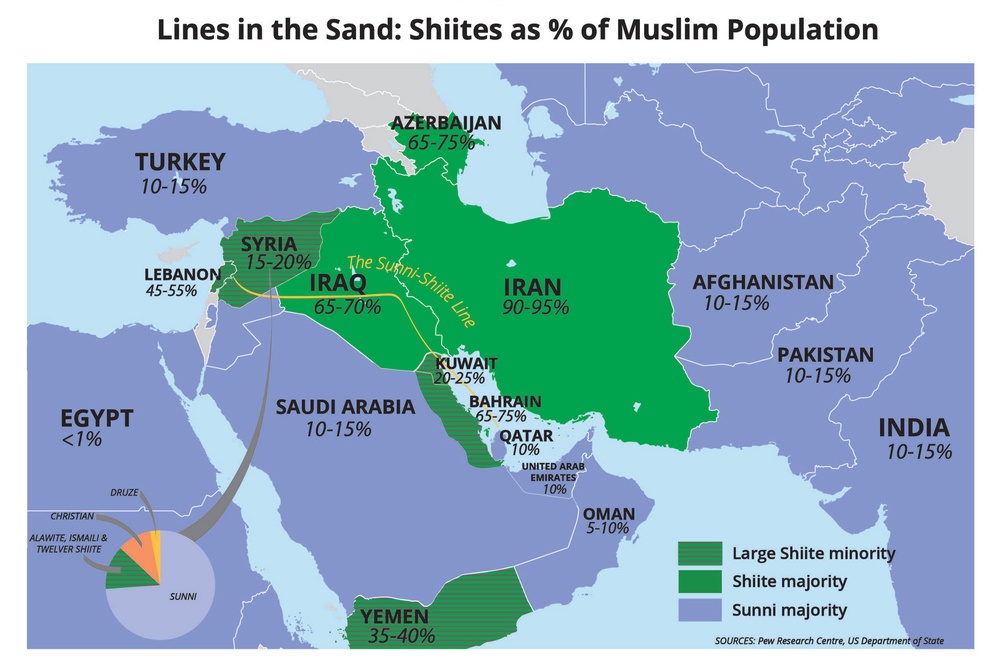
 The map above shows the majority-Shiites (light green) and the large-minority-Shiite (dark green) nations contained within a vast monolithic Sunni ocean (blue-gray). They have been inextricably intertwined in the entire Middle East for many centuries since the Prophet Mohamed died, with very little chances of reconciliation, a key ingredient to World War III.
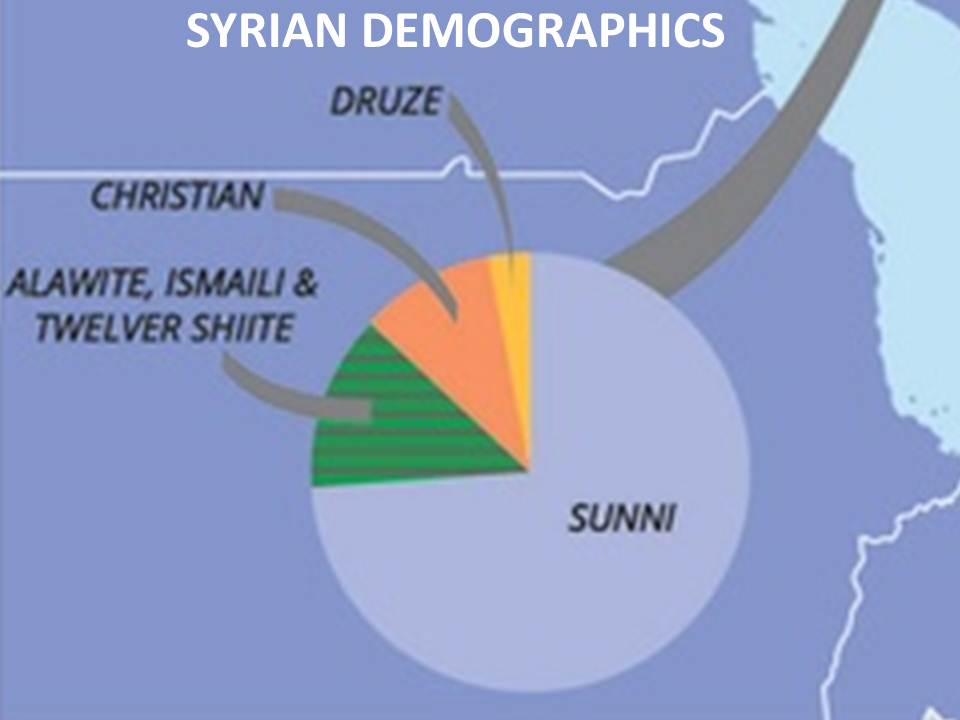
The pie graph zooms in to the Syrian demographics, where the majority Sunnis are fighting the minority Assad Shiite regime, just like in Yemen, where the majority Shiite Houthis are fighting the minority Sunni regime, and where the Saudi (pro-Sunni) and Iran (pro-Shiite) are involved. This was the same in Saddam’s minority Sunni regime in Iraq versus the majority Shiite rebels before the US invasion. Ironically, the power vacuum due to the US invasion of Iraq triggered a more intensified Sunni-Shia war which rages to this day. A majority populace always rebels against an oppressive minority regime, the key ingredient to the rise of the Arab Spring.
There are five ingredients to World War III – 1) proxy wars where outside powerful nations dip their fingers in local affairs, inducing rapid escalation; 2) the irreconcilable Sunni-Shia dilemma; 3) indiscriminate massacres of civilians inducing the growth of terrorism; 4) a protracted global energy crisis; and 5) millions of refugees from war-torn nations overflowing unchecked towards affluent nations (EU, UK, US), undermining the social fabric and inducing civil riots and wars.
Present game-changers to the Syrian war may include – 1) Egypt’s entry into the Syrian War; 2) the death of Assad leading to a Sunni interregnum, 3) Trump’s Middle East moves for or against Sunni or Shia, NATO or Russia, 4) the regroupings of rebels and ISIS after Aleppo (US concern) and Mosul (Russia concern) fall.
Historical Note. The Sunni-Shiite splinter began right after Prophet Mohamed died. The Shiite group was his relatives in the inner circle, the Sunni the non-relatives. The Sunnis were the dominant warriors during the spread of the Islamic empire, and the catalysts to the subsequent Islamic renaissance. Bernie V. Lopez eastwindreplyctr@gmail.com .
HOW FILIPINOS DEAL WITH DISASTERS
http://www.sisterraquel.com/2017/01/how-pinoys-deal
******************************
Ministry Meditation Posters
The map above shows the majority-Shiites (light green) and the large-minority-Shiite (dark green) nations contained within a vast monolithic Sunni ocean (blue-gray). They have been inextricably intertwined in the entire Middle East for many centuries since the Prophet Mohamed died, with very little chances of reconciliation, a key ingredient to World War III.
The pie graph zooms in to the Syrian demographics, where the majority Sunnis are fighting the minority Assad Shiite regime, just like in Yemen, where the majority Shiite Houthis are fighting the minority Sunni regime, and where the Saudi (pro-Sunni) and Iran (pro-Shiite) are involved. This was the same in Saddam’s minority Sunni regime in Iraq versus the majority Shiite rebels before the US invasion. Ironically, the power vacuum due to the US invasion of Iraq triggered a more intensified Sunni-Shia war which rages to this day. A majority populace always rebels against an oppressive minority regime, the key ingredient to the rise of the Arab Spring.
There are five ingredients to World War III – 1) proxy wars where outside powerful nations dip their fingers in local affairs, inducing rapid escalation; 2) the irreconcilable Sunni-Shia dilemma; 3) indiscriminate massacres of civilians inducing the growth of terrorism; 4) a protracted global energy crisis; and 5) millions of refugees from war-torn nations overflowing unchecked towards affluent nations (EU, UK, US), undermining the social fabric and inducing civil riots and wars.
Present game-changers to the Syrian war may include – 1) Egypt’s entry into the Syrian War; 2) the death of Assad leading to a Sunni interregnum, 3) Trump’s Middle East moves for or against Sunni or Shia, NATO or Russia, 4) the regroupings of rebels and ISIS after Aleppo (US concern) and Mosul (Russia concern) fall.
Historical Note. The Sunni-Shiite splinter began right after Prophet Mohamed died. The Shiite group was his relatives in the inner circle, the Sunni the non-relatives. The Sunnis were the dominant warriors during the spread of the Islamic empire, and the catalysts to the subsequent Islamic renaissance. Bernie V. Lopez eastwindreplyctr@gmail.com .
HOW FILIPINOS DEAL WITH DISASTERS
http://www.sisterraquel.com/2017/01/how-pinoys-deal
******************************
Ministry Meditation Posters
 amdg
amdg
 Eastwind Journals